While Europe’s financial crisis continues India grew GDP by 8.6% in the first 3 months of 2010. China continues to grow quickly as do many emerging countries, including Brazil. India’s Q4 GDP grows at 8.6% y-o-y
India’s economy had grown 6.7 percent in 2008/09, and the Jan-March 2009/10 growth rate matches the revised data for the second quarter of 2009/10.
…
Manufacturing output grew 16.3 percent on year in the quarter as consumers bought more cars and other goods, while farm output grew an annual 0.7 percent helped by a good winter harvest. The government expects the economy to grow 8.5 percent in the current fiscal year that started on April 1 on the prospects of a better farm output and a global recovery
…
The farm sector, which forms nearly 17 percent of the economy but is dependent on monsoon rains, is expected to do well in 2011 as the weather office has predicted a normal monsoon for the country. Prime Minister Manmohan Singh last week said an annual economic growth rate of 10 percent is needed in the medium term to address the problems of poverty and malnutrition.
Even as Singh aims for high economic growth, inflation has come to haunt his government and appears to be undermining its support base. Wholesale prices, the most closely watched inflation gauge in India, rose 9.59 percent in April from a year earlier amid the government officials claim that headline inflation had peaked.
Headline inflation numbers have been consistently higher than the official forecasts. The wholesale price inflation vaulted above the RBI’s end-March 2010 inflation forecast of 8.5 percent in January and crossed the 10-percent mark in February.
Although food price inflation has eased from its peak of 20 percent in December, it is still above 16 percent. Rising cost pressures are also dragging down the pace of manufacturing growth, as evidenced by a second-straight monthly decline in the HSBC Market Purchasing Managers’ Index in April. The rapid acceleration in the world’s second-fastest growing major economy after China is boosting consumer demand far ahead of what can be met by existing supply capacity.
The economies of India, China, Brazil, Mexico, Thailand, Vietnam… are still a fairly small fraction of global GDP but their share continues to grown. And the next few years look to continue this trend. Keys to how quickly they grow their share of global GDP are avoiding bubbles (which then burst), avoiding excessive government debt, continuing to build strong infrastructure for continued development and to what extent growth slows in Europe, USA and Japan due to the credit crisis and excessive consumer and government debt.
The emerging economies have done a good job avoiding the credit crisis failures visited by the large banks on the wealthiest economies but the dangers of slipping up are large and costly. The largest economies have lots of wealth even after allowing bankers and wall street to siphon off huge amounts for themselves. Less wealth economies will suffer much more than the wealthiest countries if they fall prey to the same political and economic failings. And those special interest (crony capitalism) favors are no less (I would say even more, in fact) likely in those countries than they are in the richest countries.
Related: The Relative Economic Position of the USA is Likely to Decline – Easiest Countries for Doing Business 2008 – Why Investing is Safer Overseas
Mark Mobius is an investment manager with Franklin-Templeton that I have invested with for over a decade (through the Templeton Emerging Markets Trust and Templeton Dragon Fund – they are closed end funds). I believe in Templeton’s emerging market investment team and Mark Mobius and believe his thoughts are worth paying attention to. He recently wrote an overview on Emerging Markets:
…
In Mexico, GDP contracted 10% y-o-y in the second quarter of 2009 as a result of the global economic crisis and swine flu outbreak. In comparison, GDP fell 8% in the first quarter of the year. Declines in the manufacturing, construction and retail sectors had negatively impacted GDP during the period.
…
Since 1995, portfolio inflows into emerging markets have totaled more than US$123 billion. A significant amount, considering it includes the US$49 billion in net outflows in 2008 as a result of the global financial crisis. The recovery in emerging markets and hunt for attractive investment opportunities, however, saw these funds return just as quickly with inflows totaling more than US$44 billion in the first seven months of 2009, nearly 90% of the outflows registered all of last year.
…
Emerging markets account for more than 80% of the world’s population. With economic growth accelerating and population growth decelerating, per capita income is one the rise. In our view, markets such as China, India and Brazil stand at the front of the class.
…
As of end-August 2009, the benchmark MSCI Emerging Markets index had a P/E of 16 times, cheaper than the MSCI World index which was trading at a P/E of 21 times.
On the heels of the Japanese economy shrinking at 12.7% rate 2 quarters ago, the Japanese economy grew at a 3.7% annual rate in the second quarter. Japan is the 2nd largest economy (after the USA). Japan’s economy leaves recession:
…
Japan is heavily reliant on its exports so growth overseas could bode well for its recovery.
…
The French and German economies both grew by 0.3% between April and June, bringing to an end recessions in Europe’s largest economies that have lasted a year. Analysts had not expected the data, suggesting recovery could be faster than previously expected.
And Hong Kong recorded growth of 3.3% in the three months from April to June. That data was also better than had been expected, with the government subsequently increasing its forecast for growth in the whole year.
The global economic recovery seems to be taking shape more quickly than anticipated. However, we are still far from in the clear. The risks to short term economic recovery are still great. And the largest long term economic problems for the USA (massive federal debt, huge consumer debt [both the government and the people living far beyond their means] and an very expensive and harmful health care system) have not been addressed. If we are very very lucky the increased saving rate in the last 6 months will continue but it is very questionable if that will continue.
Related: Manufacturing Employment Data, 1979 to 2007 – Government Debt as a Percentage of GDP – Politicians Again Raising Taxes On Your Children (Jan 2008)
The Indian stock market surged 17% today on the election results that gave the Congress party an unexpectedly decisive victory. The market was closed early due to the huge spike in prices. The Indian stock market was up 26% this year, before the move today.
Landslide in India Vote Reshapes Landscape
…
Even with a free hand, the Congress-led government will face formidable challenges. India needs to swiftly build roads, highways and power plants; improve public schools and build universities for a swelling young population; and hire nurses and doctors for its feeble public health system. Most of all, it needs to address its abiding poverty. Despite over a decade of high economic growth in India, 300 million people remain below the poverty line.
Driving India’s Economic Reforms
India has great potential and great problems. India has poor physical infrastructure and crippling bureaucracy; India ranked the 122nd easiest country for doing business. The election results are giving investors hope the government will be able to make progress to improve the business climate, which will improve economic performance.
Related: Emerging-market Multinationals – Why Investing is Safer Overseas (Jun 2007) – World’s Wealthiest People – Top 12 Manufacturing Countries in 2007
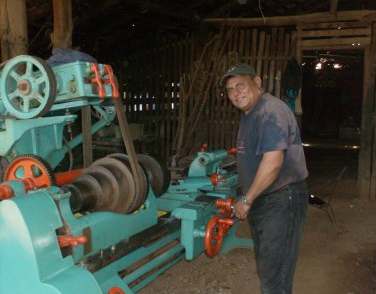 photo of Cesar Augusto SantamarÃa Escoto in his welding workshop, Chinandega, Nicaragua.
I made my 100th contribution to a micro-loan through Kiva last week. Participating with Kiva is a great antidote to reading about the unethical “leaders” taking huge sums to run their companies into the ground (or even just taking obscene sums to maintain their company). The opportunity to give real capitalists an chance at a better life is wonderful.
Kiva allows you to lend money to entrepreneur (in increments of $25). The most you get back is the amount you loaned, and if the entrepreneur, does not pay back the loan then you take a loss. This is something you do if you believe if giving people an opportunity to make a better life for themselves through hard work and intelligent economic choices.
I encourage you to join me: let me know if you contribute to Kiva and I will add your Kiva page to our list of Curious Cat Kivans. Also join the Curious Cats Kiva Lending Team.
My loans have been made to in 32 countries including: Ghana, Cambodia, Uganda, Viet Nam, Peru, Ukraine, Mongolia, Ecuador and Tajikistan. Kiva provides sector (but I think this data is a not that accurate – it depends on the Kiva partners that are not that accurate on identifying the sectors (it seems to me). A large number of the loans are in retail, clothing and food. I like making loans that will improve productivity (manufacturing, providing productivity enhancing services…) but can’t find as many of those as I would like (8% of my loans are in manufacturing, 11% agriculture, retail 18%, 23% food, 25% services (very questionable – these are normally really retail or food, it seems to me).
Some examples of the entrepreneurs I have lent to: welding workshop (Nicaragua), expanding generator services business with computer services (Cambodia), food production (Ghana), manufacturing nylon (Nigeria), internet cafe (Lebanon), electronics repair (Benin), new engine for mill (Togo), weaving (Indonesia) and a food market (Mexico).
Related: Financial Thanksgiving – MicroFinance Currency Risk – Creating a World Without Poverty – Provide a Helping Hand
21 of my loans have been paid back in full. 3 have defaulted. Those figure give a distorted picture though (I believe). There was a problem with a Kiva partner (they partner with micro-finance banks around the world) MIFEX, in Ecuador. Kiva discovered that MIFEX (i) improperly inflated the loan amounts it posted for entrepreneurs on the Kiva website and (ii) kept the excess amount of the posted loan to fund its own operational expenses. Kiva does not expect any further payments on these loans. I had 2, so I think those 2 give a fair impression. The 3rd default is from Kenya. That loan was to a business selling bicycle parts. In 2008, in Kenya, the prevailing political crisis deteriorated and businesses have either been destroyed or closed in fear of looters. Technically the loan did default, however, I was paid $71.50 out of $75 loan (so the defaulted amount was very small.
Read more
Global manufacturing recession continued in February. From the Institute for Supply Management, the USA is in the 13th consecutive month of contraction:
Japanese Factory Output Posts Record Drop in January
European Manufacturing Contracts at Record Pace
…
The manufacturing index for Germany, Europe’s largest economy, was at 32.1 in February, lower than the initially reported 32.2, according to a separate report. Italy’s dropped to 35 from 36.1 and the French gauge declined to 34.8 from 37.9, less than the initial estimate.
…
The International Monetary Fund predicts the euro area economy will contract 2 percent this year.
In Korea, industrial output shark 26% in January, the largest decline even (statistics available since 1970). A one month period is not very significant but with a 26% decline that is still huge. And the December decline was 19%
China appears to be slowing the least of any sizable manufacturer:
It was the third straight month that the PMI came in higher than the month before, which provided some hope that China’s economy, which grew at its slowest pace in seven years in the fourth quarter of 2008, might be starting to stabilize. But economists are far from declaring an economic rebound.
Related: Manufacturing Employment Data from 1979 to 2007 – Top 12 Manufacturing Countries in 2007 – The Economy is in Serious Trouble – Japanese Economy Shrinks 12.7% – USA Job Growth (2007)
As many as 10,000 corrupt government officials have fled China with $100 billion.
More unexpected, however, was the heavy press coverage that Yang’s walkabout attracted in a country where the government is generally reluctant to wash its dirty linens in public. That suggests that “the government is sending a signal” that it regards “the number of officials fleeing as a very important problem which needs to be solved,” says Mao Zhaohui, director of anticorruption studies at Beijing’s Renmin University.
Corruption is pervasive at almost every level of the government, and it is a major factor eroding faith in the ruling Communist Party. Earlier this year, after thousands of schoolchildren died in the Sichuan earthquake, the Internet was ablaze with accusations that local officials had taken bribes to approve substandard materials for school construction.
Chinese President Hu Jintao has repeatedly declared that the fight against fraud is a top government priority and courts have handed down heavy sentences against prominent offenders. Last year, the former head of the Chinese Food and Drug Administration, Zheng Xiaoyu, was executed after being found guilty of taking bribes to approve thousands of new drugs.
China has many strong winds for economic growth. Corruption is an anchor holding back their progress.
Related: Capitalism in China – Not Understanding Capitalism – Oil Consumption by Country – Data on Leading Manufacturing Countries – Curious Cat Economics Search Engine
The updated data from the United Nations on manufacturing output by country clearly shows the USA remains by far the largest manufacturer in the world. UN Data, in billions of current US dollars:
| Country | 1990 | 1995 | 2000 | 2005 | 2006 | 2007 |
|---|---|---|---|---|---|---|
| USA | 1,041 | 1,289 | 1,543 | 1,663 | 1,700 | 1,831 |
| China | 143 | 299 | 484 | 734 | 891 | 1,106 |
| Japan | 804 | 1,209 | 1.034 | 954 | 934 | 926 |
| Germany | 438 | 517 | 392 | 566 | 595 | 670 |
| Russian Federation | 211 | 104 | 73 | 222 | 281 | 362 |
| Italy | 240 | 226 | 206 | 289 | 299 | 345 |
| United Kingdom | 207 | 219 | 228 | 269 | 303 | 342 |
| France | 224 | 259 | 190 | 249 | 248 | 296 |
| Korea | 65 | 129 | 134 | 200 | 220 | 241 |
| Canada | 92 | 100 | 129 | 177 | 195 | 218 |
| Spain | 101 | 103 | 98 | 164 | 176 | 208 |
| Brazil | 120 | 125 | 96 | 137 | 170 | 206 |
| Additional countries of interest – not the next largest | ||||||
| India | 50 | 59 | 67 | 118 | 135 | 167 |
| Mexico | 50 | 55 | 107 | 122 | 136 | 144 |
| Indonesia | 29 | 60 | 46 | 80 | 102 | 121 |
| Turkey | 33 | 38 | 38 | 75 | 85 | 101 |
The USA’s share of the manufacturing output of the countries that manufactured over $200 billion in 2007 (the 12 countries on the top of the chart above) in 1990 was 28%, 1995 28%, 2000 33%, 2005 30%, 2006 28%, 2007 27%. China’s share has grown from 4% in 1990, 1995 7%, 2000 11%, 2005 13%, 2006 15%, 2007 16%.
Total manufacturing output in the USA was up 76% in 2007 from the 1990 level. Japan, the second largest manufacturer in 1990, and third today, has increased output 15% (the lowest of the top 12, France is next lowest at 32%) while China is up an amazing 673% (Korea is next at an increase of 271%).
Read more
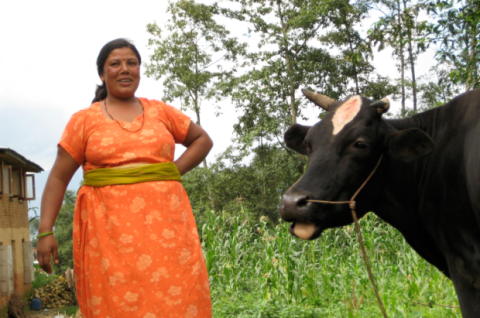
Kiva has added a fellows blog – which is a great idea. The fellows are funded by Kiva (fellows are unpaid) to go to spend time in the countries Kiva facilitates loans for working with the local partners. This post is about Rita Bashnet (in photo) an entrepreneur from Nepal:
…
Five years ago, Ms. Rita took her first loan of NRs. 10,000 (USD $150) and purchased some extra seed and fertilizer in the hopes of expanding her small vegetable patch. With the profits from this initial investment and a second loan from Patan Business and Professional Women (they offer a graduated loan program), she then purchased her first dairy cow.
…
After hearing about a program that subsidized the installation of methane gas storage tanks, Ms. Rita took another loan and applied for the program. With this new system, she is now able to capture the valuable gas released from her cow’s waste in a simple controlled-release storage tank. Today she no longer purchases gas from the city and can even sell some during times of shortage.
…
Ms. Rita exemplifies the potential of microfinance. A combination of access to capital and strategic investment has allowed her and her family to drastically improve their economic situation in a short five years.
Great story, and exactly my hope for using capitalism to improve the standard of living for people around the globe. I notice today, for the first time, some of those seeking loans are about to have their listings expire unfunded. Kiva gives listings 30 days to be funded. I have no problem if some loans are not funded (I want to help entrepreneurs by providing funding to build a business – some loans are for things like adding a room onto their house, which is fine but not what I want to support with interest free loans from me). But, this is a big change from when I couldn’t find anyone to loan to (they had so many people looking to lend that they didn’t have enough loans to fund). If you haven’t loaned money through Kiva (or you haven’t added to your loan portfolio recently), please consider it now. If you do, send me your Kiva lender link and I will add it to Curious Cat Kivans. My biggest wish for this blog is to get more readers listed on that page.
Related: Using Capitalism to Make a Better World – Funding Entrepreneurs in Nicaragua, Ghana, Viet Nam, Togo and Tanzania – 2006 Nobel Peace Prize to Economist – Frontline Explores Kiva in Uganda – Trickle Up
I have made some additional loans through Kiva, $250 for 5 loans in: Nicaragua, Ghana, Viet Nam, Togo and Tanzania. I have now made 37 loans for a total of $1,775. 5 loans of $250 have been paid back (and I relent the proceeds). Kiva says 5.64% are delinquent. While they show my delinquency rate they don’t show me which loans are delinquent. Frankly I think that figure may be in error (maybe it is counting one that was delinquent but is not now – see next paragraph). In any event all loans appear to have been paid off in full on time or are being paid in full now on time.
In any event no loans are in default. One loan in Kenya for bike repair shop (that for whatever reason I especially liked) and did connect me more to the troubles in Kenya recently. Kiva mentioned many banks were having trouble keeping in touch with clients as many people fled violence. For two months there was no activity then there was a payment for 3 full months. I was happy when a new payment came in, not for the money being repaid (which shows again that my aim with this money is not a return for me but to provide opportunities to entrepreneurs), but for confirmation he was doing well.
Photo of Cesar Augusto SantamarÃa Escoto in his welding workshop, Chinandega, Nicaragua.
If you have a Kiva page, let me know and I will add a link to it on the Curious Cat Kivans page.
Related: Provide a Helping Hand – Microfinancing Entrepreneurs – Entrepreneurship posts on the Curious Cat Science and Engineering blog