You should review your credit reports annually (at least) to correct any errors. Also doing so can be a tool to help you spot identity theft.
The real free credit report site (for those in the USA), annualcreditreport.com, is provided by government regulation (so those that don’t believe in regulation would maybe rather use one of the sites advertising “free” credit reports). But I suggest using the government provided reports and I would suggest spreading the requests out during the year (you get 3 a year, 1 from each of the nationwide consumer credit reporting companies).
The site also has a large frequently asked question section including:
How do I request a “fraud alert” be placed on my file?
You have the right to ask that nationwide consumer credit reporting companies place “fraud alerts” in your file to let potential creditors and others know that you may be a victim of identity theft. A fraud alert can make it more difficult for someone to get credit in your name because it tells creditors to follow certain procedures to protect you. It also may delay your ability to obtain credit. You may place a fraud alert in your file by calling just one of the three nationwide consumer credit reporting companies. As soon as that agency processes your fraud alert, it will notify the other two, which then also must place fraud alerts in your file.
Where can I find out more about credit reports, my rights as a consumer, the Fair Credit Reporting Act and the FACT Act?
Please visit www.ftc.gov/credit
Related: Credit Card Tips – Personal Finance Basics: Avoid Debt – Save Some of Each Raise – Personal Finance Basics: Long Term Disability Insurance
Most people know living without health insurance is very risky (and shouldn’t be done). But people are much less aware of the importance of long term disability insurance. The census bureau estimates that you have a 20% chance you will be disabled in your lifetime. A disability can decrease your earning power and also can increase your expenses (to cope with your disability). In my opinion your emergency fund is best used for short term disability insurance.
One of the most important things you can do is be sure you have disability coverage. In the USA about 50% of the jobs provide coverage. If your job does not you should get insurance yourself. Many companies may not pay for disability insurance but may allow you to pay for it (this often can be the best option as the company can gain a better price than individuals but you have to check out the details). Also social security includes some disability insurance coverage but it is very limited. Relying on social security alone is not wise. For one thing it does not protect you from being unable to do your current job but will only pay benefits if you are unfit to do any job.
There are numerous factors to consider for disability insurance. Normally a long term disability insurance policy will pay 50-60% of your salary (be sure to check and see, and check if there is any cap). The terms of the policy will also determine how long you will be paid, being paid until at least 65 is what I would suggest – but some only pay for a limited number of years.
Often policies will offer pro-rated benefits if you earning power is reduced by a disability but you are still able to earn something. So you may have a policy that pay 60% of your original salary but if you make 50% of your previous salary then the payout is reduce to say 20%. So if you originally made $80,000 and now, due to a disability (not just losing your job), you could no longer do your job but could do one that paid less – say $40,000. You would then get your new salary of $40,000 + $16,000 in disability payments or $56,000.
Another detail you should check is whether the payments you will receive are indexed to inflation. In addition, make sure the policy is guaranteed renewable. You also want to buy from a reputable insurance company (check AM Best, Moody’s, Weiss rating agencies). It doesn’t help to have a guaranteed renewable policy if the insurance company goes out of business.
Another thing to consider is buying additional disability coverage. For example, if your company provides a 60% coverage policy it is often possible to purchase addition coverage (to provide additional benefits of 10% or 20% or more of your current salary).
A rough guide is disability insurance will cost 1-2% of the income replaced. For example, a policy replacing $50,000 per year of annual salary would cost about $1,000 per year. Of course, the older or sicker you are the higher the cost. Premiums are based on risk factors, so if you have health risks that will cost more. And, as age is a significant disability factor, the older you are the higher the cost will be.
Remember if you have disability insurance through work, and lose you job you need to get your own disability insurance. This is yet another reason to have an adequate emergency fund.
Related: Personal Finance Basics: Long-term Care Insurance – Personal Finance Basics: Health Insurance – How to Protect Your Financial Health – Life Happens: disability insurance
Earning more is an important and simple idea that is ignored far to often. Simple, doesn’t mean, easy, just easy to understand. This is something people should definitely consider in their personal financial planning.
There is a important caveat to remember, people earning a lot of money often have large financial problems and go bankrupt. Earning more if you borrow more than you earn and rely on ever increasing earnings can make you even more venerable than those earning less. A significant factor is how likely you are to replace your current earning if you need to find a new job.
There is also another concern to watch for – don’t become a slave to your desire to earn more. The reason to earn more is to improve your life long situation. If you sacrifice what you enjoy too much it becomes a bad trade off. Short term sacrifices may well be wise. But many people find themselves in decades long sacrifices to try and get ahead. This isn’t a good plan.
Making money online can be enjoyable and rewarding. However, it isn’t easy. I am putting more effort into this area and will be doing a great deal more in the next year. We will see how successful I am.
Related: Earn more money. It matters more than everything else combined. – 10 Jobs That Provide a Great Return on Investment – Earn More Money to buy luxuries (don’t go into debt) – High Expectations
Read more
The biggest investing failing is not saving any money – so failing to invest. But once people actually save the next biggest issue I see is people confusing the investment risk of one investment in isolation from the investment risk of that investment within their portfolio.
It is not less risky to have your entire retirement in treasury bills than to have a portfolio of stocks, bonds, international stocks, treasury bills, REITs… This is because their are not just risk of an investment declining in value. There are inflation risks, taxation risks… In addition, right now markets are extremely distorted due to the years of bailouts to large banks by the central banks (where they are artificially keeping short term rates extremely low passing benefits to investment bankers and penalizing individual investors in treasury bills and other short term debt instruments). There is also safety (for long term investments – 10, 20, 30… years) in achieving higher returns to gain additional assets – increased savings provide additional safety.
Yes, developing markets are volatile and will go up and down a lot. No, it is not risky to put 5% of your retirement account in such investments if you have 0% now. I think it is much riskier to not have any real developing market exposure (granted even just having an S&P 500 index fund you have some – because lots of those companies are going to make a great deal in developing markets over the next 20 years).
I believe treating very long term investments (20, 30, 40… years) as though the month to month or even year to year volatility were of much interest leads people to invest far too conservatively and exacerbates the problem of not saving enough.
Now as the investment horizon shrinks it is increasing import to look at moving some of the portfolio into assets that are very stable (treasury bills, bank savings account…). Having 5 years of spending in such assets makes great sense to me. And the whole portfolio should be shifted to have a higher emphasis on preservation of capital and income (I like dividends stocks that have historically increased dividends yearly and are likely to continue). And the same time, even when you are retired, if you saved properly, a big part of your portfolio should still include assets that will be volatile and have good prospects for long term appreciation.
Related: books on investing – Where to Invest for Yield Today – Lazy Portfolios Seven-year Winning Streak (2009) – Fed Continues Wall Street Welfare (2008), now bankers pay themselves huge bonuses because the Fed transferred investment returns to too-big-to-fail-banks from retirees, and others, investing in t-bills.
I have posted about the need to save money while you are working numerous times. Here is a good article looking at the large number of people that have failed to do so and are now retiring.
Retiring Boomers Find 401(k) Plans Fall Short
…
Vanguard long advised people to put 9% to 12% of their salaries—including the employer contribution—in their 401(k) plans. The current median amount that people contribute is 9%, counting the employer contribution, Vanguard says.
Recently, Vanguard has begun urging people to contribute 12% to 15%, including the employer contribution, because of the stock market’s weak returns and uncertainty about the future of Social Security and Medicare.
…
Experts estimate Social Security will provide as much as 40% of pre-retirement income, or $35,080 a year for that median family. That leaves $39,465 needed from other sources. Most 401(k) accounts don’t come close to making up that gap.
The median 401(k) plan held $149,400, including plans from previous jobs, according to the Center for Retirement Research. To figure the annual income from that, analysts typically look at what the family would get from a fixed annuity. That $149,400 would generate just $9,073 a year for a couple, according to New York Life Insurance Co., the leading provider of such annuities— less than one-quarter of the $39,465 needed.
Just 8% of households approaching retirement have the $636,673 or more in their 401(k)s that would be needed to generate $39,465 a year.
Knowing exactly what is needed for retirement is difficult. But knowing what is a responsible amount is not. It is certainly no less than 8%, and is likely the 12-15% figure Vanguard recommends. If you start at 10% from the time you join the full time workforce (in your 20’s) then you have some flexibility you can see how thing look when you are 30, maybe 12% is sensible, maybe 15%, maybe 10%. If you fail to save for a decade however, you are likely to need to be at 15%, or higher.
Read more
Unfortunately large banks have a very strong tendency to try to take as much of your money as they can get away with. Rather than having to stay ultra-vigilante (as though I am in business with a thief that I have to watch ever minute or expect my money to be stolen) I would rather pick those I going into business with to avoid those seeking to rip me off. Credit unions are usually the best bet. Some credit unions join nationwide ATM networks, so if ATMs are important to you check this out before selecting a credit union.
Hate ATM fees? Try these fee-friendly banks
If you’re looking to avoid those fees, Ally, Charles Schwab (SCHW, Fortune 500) and USAA not only let all of their customers use out of network ATMs free of charge, but they also refund the fees that their customers are charged by other banks. State Farm Bank doesn’t charge you for going out of network and reimburses fees of up to $10 charged by other banks.
In general, the best advice is to avoid large banks like you would someone with a dangerous communicable disease.
BankSimple is a very promising new offering from Alex Payne, one of Twitter’s first employees and CTO of BankSimple, that promises “to simply put people first. Real customer service, no surprise fees, and a deep desire to help people is what makes BankSimple different.” Now the large banks are perfectly comfortable saying they try to help while trying to find any way possible to trick customers out of money. So Banksimple’s words don’t mean much. but I think there is a real chance they will be different. It is a great market to be in, huge amounts of money to be made and your competitors all treat customers egregiously poorly. That should give you a great opportunity to gain a huge market share.
They are not yet open for business but it might open in early 2011. They are not actually going to be a bank, but instead provide the customer value and partner with existing banks (so we can deal with someone that isn’t trying to rip us off and they can let some bank deal with the administration of managing the money.
Related: Worst Business Practices: Fees to Pay Your Bills – Credit Card Regulation Has Reduced Abuse By Banks – FDIC Study of Bank Overdraft Fees – Sneaky Fees
In the USA we fail to save nearly enough for retirement by and large. And fail to save emergency funds or prepare for economically difficult times. We by and large chose to spend today and hope tomorrow will be good rather than first establishing a good financial safety net before expanding spending.
When people are debating withdrawing from their retirement account it is actually not the important decision it seems to be (normally). Normally the important decision was years before when they chose to take on consumer debt and not to build up an emergency fund. And when they failed to just build up saving beyond that which could be used for nice vacations, a new car, or to live on in economically challenging times.
If someone had been saving 15% of their salary in retirement since they started working if they took an amount that left them at 10% that is hardly a horrible result. While someone that was already behind by say adding just 3% to retirement savings and they took out all of it that would be much worse.
And we should remember even having a retirement account to withdraw from might put you ahead of nearly 50% of the population (and our state and federal governments, by the way). If you have to resort to withdrawing from your retirement account don’t think of that as the failure. The failure was most likely the lack of savings for years prior to that. And as soon as possible, re-fund your retirement account and build up a strong emergency fund, even if that means passing spending on things you want.
Related: Retirement Savings Allocation for 2010 – 401(k)s are a Great Way to Save for Retirement – Save Some of Each Raise
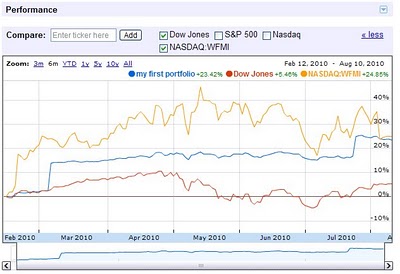
Google finance has a nice new feature to let you chart your entire portfolio. You can then compare it to the S&P 500 or other stocks. This is a very nice feature. Yahoo Finance is about the only part of Yahoo I still use. I do use Google Finance some but they still fall short and I use Yahoo Finance much more. This feature will at least encourage me to put my portfolio in Google and start tracking it.
It would be great if this could give you portfolio annual rates of return (including factoring in cash additions and withdraws and keeping track of sales over time to show a true view of the portfolio). It does look like it will factor in stock purchases and sales which is very nice. You can import csv files with transaction history – another nice feature.
It also strikes me as a very smart move (as a Google stockholder that is nice to see) as advertising rates around investing are high. The more time Google can provide financial advertisers the more income they can make.
Related: Lazy Portfolios Seven-year Winning Streak – Google Posts Good Earning But Not Good Enough for Many (April 2010) – Dollar Cost Averaging – Curious Cat Investing Books
Options strike most as exotic investment transactions. And some option strategies can be risky. But stock options can also be used in ways that are not risky. Call options give you the right to buy a stock at a certain price (the strike price) on, or before, a certain date (the expiration date). So if you want to speculate that a stock will go up in a short period of time you can buy call options. This is a risky investment strategy – though it can pay off well if you speculate correctly.
Someone has to sell the call option. The seller gives the buyer the right to buy a stock at a certain price by a certain date. A speculator can do this and take the risk that the price will not rise to the level where a person chooses to exerciser their option. The also carries a significant risk, as if the stock price rises the speculator that sold the option has to either buy the option back (at a significant cost) or provide the stock (which they would have to purchase on the market). In order to trade in options you must be approved by the broker (at least in the USA) as an investor with the knowledge, finances and goals for which options trading is appropriate.
An investor can also sell an option to buy a stock they own – this is called selling a covered call option. This means you get the price the speculator is willing to pay to buy the option and may have to sell the stock you own if the person holding the option chooses to exercise it.
Lets look at an example. Lets say you own some Amazon stock. Read more
Law enforcement officers, pre-Kindergarten through 12th grade teachers and firefighters/emergency medical technicians can contribute to community revitalization while becoming homeowners through HUD’s Good Neighbor Next Door Sales Program. HUD (United States Department of Housing and Urban Development) offers a substantial incentive in the form of a discount of 50% from the list price of the home. In return you must commit to live in the property for 36 months as your sole residence.
Eligible Single Family homes located in revitalization areas (there are hundreds of revitalization areas across the country. HUD is always working with localities to designate new areas) are listed exclusively for sales through the Good Neighbor Next Door Sales program. Properties are available for purchase through the program for five days.
Check the listings for your state. Follow the instructions to submit your interest in purchasing a specific home. If more than one person submits on a single home a selection will be made by random lottery. You must meet the requirements for a law enforcement officer, teacher, firefighter or emergency medical technician and comply with HUD’s regulations for the program.
HUD requires that you sign a second mortgage and note for the discount amount. No interest or payments are required on this “silent second” provided that you fulfill the three-year occupancy requirement.
Related: Fixed Mortgage Rates Reach New Low – Your Home as an Investment – articles on home ownership