• curiouscat.com
  • About
  • Books
  • Glossary


    Categories

    • All
    • carnival (24)
    • Cool (34)
    • Credit Cards (41)
    • economic data (12)
    • Economics (390)
    • economy (84)
    • Financial Literacy (246)
    • Investing (252)
    • Personal finance (297)
    • Popular (37)
    • quote (178)
    • Real Estate (106)
    • Retirement (54)
    • Saving (79)
    • Stocks (117)
    • Taxes (43)
    • Tips (120)
    • Travel (4)
  • Tags

    Asia banking bonds capitalism chart China commentary consumer debt Credit Cards credit crisis curiouscat debt economic data Economics economy employment energy entrepreneur Europe Financial Literacy government health care housing interest rates Investing Japan John Hunter manufacturing markets mortgage Personal finance Popular quote Real Estate regulation Retirement save money Saving spending money Stocks Taxes Tips USA Warren Buffett webcast
  • Recently Posts

    • USA Apartment Market in 2011
    • 243,000 Jobs Added in January Bring the USA Unemployment Rate Down to 8.3%
    • Curious Cat Investing, Economics and Personal Finance Carnival #24
    • USA Spends $7,960 Compared to Around $3,800 for Other Rich Countries on Health Care with No Better Health Results
    • Apple’s Impossibly Good Quarter
    • Health Care in the USA Cost 17.9% of GDP, $2.6 Trillion, $8,402 per person in 2010
    • Looking at GDP Growth Per Capita for Selected Countries from 1970 to 2010
    • Curious Cat Investing, Economics and Personal Finance Carnival #23
    • 12 Stocks for 10 Years: January 2012 Update
    • USA Adds 200,000 Jobs in December, Unemployment Rate Falls to 8.5%
  • Blogroll

    • Curious Cat Management Improvement Blog
    • Freakonomics
    • I Will Teach You to be Rich
    • Jubak Picks
  • Links

    • Articles on Investing
    • fool.com
    • Investing Books
    • Investment Dictionary
    • Leading Investors
    • Marketplace
    • Trickle Up
  • Subscribe

    • RSS Feed

    Curious Cat Kivans

    • Making a Difference

Investing and Economics Blog

Federal Funds Rate and 30 Year Fixed Mortgage Rate

I have update my article showing the historical comparison of 30 year fixed mortgage rates and the federal funds rate. When deciding whether to lock in a rate for a 30 year fixed rate mortgage (when refinancing or buying a new home) some believe moves in the federal reserve discount rate will raise or lower that mortgage rate directly. This is not the case, in general. The effect of federal reserve discount rates on other mortgage rates (such as adjustable rate mortgages is not the same and can be predictably affected by fed fund rate moves).

The chart shows the federal funds rate and the 30 year fixed rate mortgage rate from January 2000 through December 2007 (for more details see the article).
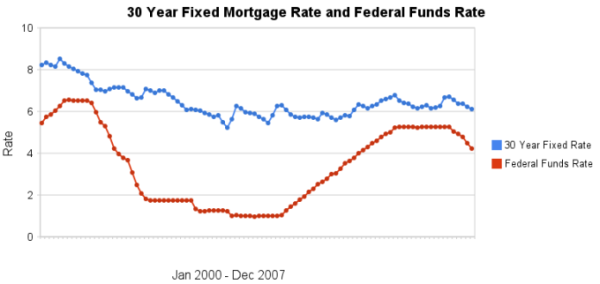
30 year fixed mortgage rates and the federal funds rate 200-2007

There is not a significant correlation between moves in federal funds rate and 30 year mortgage rates that can be used for those looking to determine short term (over a few days, weeks or months) moves in the 30 year fixed mortgage rates. For example if 30 year rates are at 6% and the federal reserve drops the federal funds rate 50 basis points that tells you little about what the 30 year rate will do. No matter how often those that should know better repeat the belief that there is such a correlation you can look at the actual data in the graph above to see that it is not the case.

30 year rates are largely effected by supply and demand of funds available for long term loans and the anticipated inflation rate. Often the federal reserve lowers the fund rate when the economy is struggling which will also normally mean that the demand for long term loans is reduced – that is the primary reason for some correlation between the rates (not that a drop or increase in federal funds rate causes the 30 year rate to move but that the same economic factor – a slow economy, for example, that prompts the federal reserve to lower rates reduces the demand of long term borrowing which can lower the rate of 30 year mortgages).

For more see: 30 year fixed mortgage rates not affected much by federal funds rate changes.

Related: real estate articles – Fed Plans To Curb Mortgage Excesses – How Not to Convert Equity – mortgage terms – Mortgage Payments by Credit Score

January 28th, 2008 by John Hunter | 5 Comments | Tags: Economics, Financial Literacy, Personal finance, quote, Real Estate

Comments

5 Comments so far

  1. Mortgage Rates Rising on March 15, 2008 8:30 pm

    “But now that person might have to pay a half percentage point more. With today’s rates, that translates into 6.75% for a 30-year fixed-rate mortgage instead of 6.25%…”

  2. Will Fed Rate Cuts Lead To Lower Mortgage Rates? : Mortgage Law Network on March 31, 2008 1:59 pm

    [...] going back at least 30 years, lowering of rates by the Fed does not co-relate with a decline in 30 year fixed mortgage [...]

  3. Fed Funds Rate Changes Don't Indicate Mortgage Rate Changes at Curious Cat Investing and Economics Blog on May 7, 2008 8:57 am

    In the last 4 months the discount rate has been reduced nearly 200 basis points, while 30 year fixed mortgage rates have fallen 18 basis points…

  4. CuriousCat: 30 Year Conventional Fixed Mortgage Rates Increase on June 9, 2008 2:20 pm

    This year, the average discount rate has fallen every month while the average 30 year mortgage rate has climbed all but 1 month (a 5 basis point drop)…

  5. Rich Crabtree on October 28, 2008 8:07 pm

    Is there any way the goverment could mandate or force the 30 year fixed mortgage rate to stay FIXED at a let’s say 5 to 5.5% giving people a fair amount of time to refinance inot long term rates?

    Has the government ever done anything like that in the past.

    Why is the 10 year bond been going up?

    It seems to me that the bailout should be for fixed long term mortgage rate reductions not LIBOR. LIBOR effects corporations lending and Long term Mortgage rates effect individuals. If the long term mortgage rates were sub 5.5% it would ignite refinancing for individuals that QUALIFY(proof of income, assets, equity). Also, those middle class individuals who qualify to refinance their mortgages would begin SPENDING a portion of the their monthly mortgage savings on other items; therefore, helping reignite the economy.

Name (required)

Email (required)

Website

Speak your mind

« Municipal Bonds – After Tax Return
Carnival of Personal Finance #137 »
Copyright © Curious Cat Investing and Economics Blog

    Personal Finance

    • Credit Card Tips
    • IRAs
    • Investment Risks
    • Loan Terms
    • Saving for Retirement
  • Archives

      All Posts
    • February 2012
    • January 2012
    • December 2011
    • November 2011
    • October 2011
    • September 2011
    • August 2011
    • July 2011
    • June 2011
    • May 2011
    • April 2011
    • March 2011
    • February 2011
    • January 2011
    • December 2010
    • November 2010
    • October 2010
    • September 2010
    • August 2010
    • July 2010
    • June 2010
    • May 2010
    • April 2010
    • March 2010
    • February 2010
    • January 2010
    • December 2009
    • November 2009
    • October 2009
    • September 2009
    • August 2009
    • July 2009
    • June 2009
    • May 2009
    • April 2009
    • March 2009
    • February 2009
    • January 2009
    • December 2008
    • November 2008
    • October 2008
    • September 2008
    • August 2008
    • July 2008
    • June 2008
    • May 2008
    • April 2008
    • March 2008
    • February 2008
    • January 2008
    • December 2007
    • November 2007
    • October 2007
    • September 2007
    • August 2007
    • July 2007
    • June 2007
    • May 2007
    • April 2007
    • March 2007
    • February 2007
    • January 2007
    • December 2006
    • November 2006
    • October 2006
    • April 2006
    • March 2006
    • January 2006
    • December 2005
    • October 2005
    • July 2005
    • May 2005
    • April 2005
    • April 2004