Total nonfarm payroll employment increased by 171,000 in October, and the unemployment rate increased at 7.9%, the U.S. Bureau of Labor Statistics reported today. Employment rose in professional and business services, health care, and retail trade. The change in total nonfarm payroll employment for August was revised from +142,000 to +192,000, and the change for September was revised from +114,000 to +148,000.
So with this report another 255,000 (171 + 50 + 34) were added, quite a good number. If we could see 250,000 jobs added for 12 more months that would be quite nice – though still will not have recovered all the jobs cost by the too-big-too-fail credit crisis.
Employment growth has averaged 157,000 per month thus far in 2012, about the same as the average monthly gain of 153,000 in 2011.
Hurricane Sandy had no discernable effect on the employment and unemployment data for October. Household survey data collection was completed before the storm, and establishment survey data collection rates were within normal ranges nationally and for the affected areas.
Long-term unemployment remains a problem, in October, the number of long-term unemployed (those jobless for 27 weeks or more) was little changed at 5.0 million. These individuals accounted for 40.6% of the unemployed (a higher percentage than normal – as it has been for the duration of the too-big-too-fail job recession.
The civilian labor force rose by 578,000 to 155.6 million in October, and the labor force participation rate edged up to 63.8%. Total employment rose by 410,000 over the month (I am guessing this is not seasonally adjusted – the highlighted figures normally quotes are seasonally adjusted figures). The employment-population ratio was essentially unchanged at 58.8%, following an increase of 40 basis points in September.
Related: Unemployment Rate Reached 10.2% (Oct 2009) – USA Economy Adds 151,000 Jobs in October and Revisions Add 110,000 More (Oct 2010, unemployment rate at 9.6%) – USA Unemployment Rate Drops to 8.6% (Nov 2011) – USA Lost Over 500,000 Jobs in November, 2008
Manufacturing employment is on a long term decline, in the USA and the world. The massive increases in productivity allow fewer and fewer people to produce more and more good. This is a good thing as it allows us to afford more good with less cost. But it does mean fewer manufacturing jobs, which are very good jobs, exist. This is a shame but something we shouldn’t anticipate changing. Believing we will globally, or in the USA, return to the huge number of manufacturing that were available previously jobs is not a wise conclusion to reach. Certainly there can be short term fluctuations that lead to increased jobs – that has happened in the last year for example.
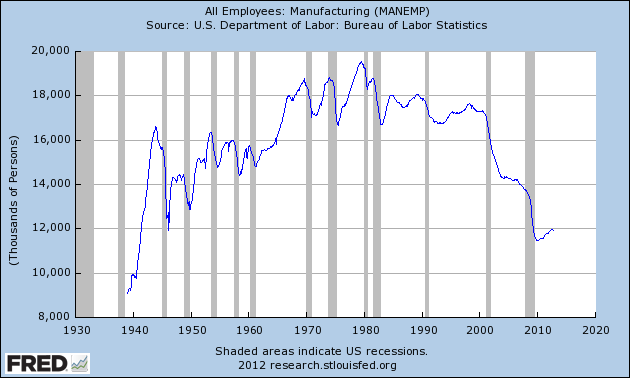
The most surprising thing to me about this graph is how stable employment was through 2000. From 1980 to 2000 the most common idea was the USA no longer manufactured anything. This idea was wrong, as I have written about previously: Chart of top 15 countries manufacturing output over time (2009) – Top 10 manufacturing countries in 2006. But I did think employment declined more from 1970 to 2000.
One factor in this perception is that the number of employed people in the USA has continued to grow. So even remaining somewhat stable from 1970 to 2000, as a percentage of the labor force the jobs kept shrinking. The more important factor that played on people emotionally is factories being shut down got much more attention in the news than new jobs being added. So the perception was tons of jobs were being lost and none were being gained.
The unemployment rate decreased to 7.8%, and total nonfarm payroll employment rose by 114,000 in September, the U.S. Bureau of Labor Statistics reported today. The change in total nonfarm payroll employment for July was revised from +141,000 to +181,000, and the change for August was revised from +96,000 to +142,000. Thus, with this report 200,000 new jobs were added (114,000 + 40,000 + 46,000).
The unemployment rate declined from 8.1% in August to 7.8% in September. For the first 8 months of the year, the rate held within a narrow range of 8.1 and 8.3%. The number of unemployed persons, at 12.1 million, decreased by 456,000 in September.
The number of long-term unemployed (those jobless for 27 weeks or more) was little changed at 4.8 million and accounted for 40.1% of the unemployed. This remains one of the most serious problems – along with the less that strong job creation numbers (since the too-big-too-fail financial crisis kicked off the great recession). In 2012, employment growth has averaged 146,000 per month, compared with an average monthly gain of 153,000 in 2011. 150,000 is decent but because of the huge job losses in the 4 years prior to 2011 there is a big recovery needed. Adding above 225,000 jobs a month, for years, would be a good result and put the economy on much firmer ground.
Health care added 44,000 jobs in September. Job gains continued in ambulatory health care services (+30,000) and hospitals (+8,000). Over the past year, employment in health care has risen by 295,000.
The average workweek for all employees on private nonfarm payrolls edged up by 0.1 hour to 34.5 hours in September. The manufacturing workweek edged up by 0.1 hour to 40.6 hours, and factory overtime was unchanged at 3.2 hours. The average workweek for production and nonsupervisory employees on private nonfarm payrolls was unchanged at 33.7 hours.
In September, average hourly earnings for all employees on private nonfarm payrolls rose by 7 cents to $23.58. Over the past 12 months, average hourly earnings have risen by 1.8 percent. In September, average hourly earnings of private-sector production and nonsupervisory employees increased by 5 cents to $19.81.
Related: Bad Jobs News in the USA, Unemployment Remains at 9.1% (Sep 2011) – USA Unemployment Rate at 9.6% (Sep 2010) – Unemployment Rate Increases to 9.7% (Sep 2009) – Over 500,000 Jobs Disappeared in November 2008
Big Income Losses for Those Near Retirement takes a look at some interesting data, including data on median income drops due to the too-big-too-fail credit crisis recession.
The post also includes data showing the only groups with income increases as those 65-74 years old and, 75 and over which is surprising. 25-34 took the 2nd largest drop decreasing 8.9%.
Another interesting tidbit is the percent of people over 65 with jobs. In 1960 20% of those over 65 had jobs. Which pretty much decreased steadily to 10% in 1986 and then has increased steadily to 17% in 2011.
Related: USA Individual Earnings Levels: Top 1% $343,000, 5% $154,000, 10% $112,000, 25% $66,000 –
Looking at Data on the Value of Different College Degrees – 60% of Workers in the USA Have Less Than $25,000 in Retirement Savings – Credit Card Regulation Has Reduced Abuse By Banks
After several poor months for job creation (adding well under 100,000 each month) we have some good news. Total nonfarm payroll employment rose by 163,000 in July, with the unemployment rate at 8.3%. Since the beginning of this year, employment growth has averaged 151,000 per month, about the same as the average monthly gain of 153,000 in 2011.
The change in total nonfarm payroll employment for May was revised from +77,000 to +87,000, and the change for June was revised from +80,000 to +64,000. Which means the total job gains for this report is 157,000 (163,000 +10,000 [for May] and -16,000 [for June]).
One of the continuing severe problems (since the credit crisis bubble burst) has been long term unemployment. In July, the number of long-term unemployed (those jobless for 27 weeks and over) was 5.2 million. These individuals accounted for 40.7% of the unemployed (a high figure historically).
Given all the problems created by the financial system failure (created over the last 15 years – in the USA and Europe) it is actually fairly amazing that we have been adding jobs nearly as much as we have. But climbing out of the huge whole we created for ourselves (by continually re-electing those that allowed the too-big-too-fail financial mess – and those we elect continue to reward their friends that created the mess instead of fixing it) is a huge task. It requires much better job creation than we have had this year.
Adding 150,000 jobs a month would be decent if we hadn’t created such a huge problem that digging out of it requires much better results. Moving back above that average is much better than being below it, but we really need to bring the new jobs created above 200,000 for a couple years to make a serious dent in the problems created earlier.
Related: USA add 117,000 Jobs in July 2011 and Adjusts Previous Growth in May and June Up 56,000 More – USA Unemployment Rate at 9.6% (Sept 2010) – Unemployment Rate Drops Slightly to 9.4% (Aug 2009) –
Over 500,000 Jobs Disappeared in November 2008
Read more
I do think there is merit to reducing yearly hours worked in the USA. The problem is this is all within a larger system. The USA’s broken health care system makes it extremely expensive to hire workers. One way to deal with the health care system failure is maximizing hours worked to spread out the massively expensive USA health care costs.
Also the USA standard of living is partially based on long hours (it is but one factor). We also have to work quite a few hours (about 5% of the total hours) to just bring us equal with other rich countries, in order to pay for our broken health care system.
Still reducing our purchases by cutting out some fancy coffee, a few pairs or shoes, a few cable channels (or all of them), text messages from overcharging phone companies… in order to have a couple more weeks of vacation would be a great tradeoff in my opinion. And one I have made with my career.
I have changed to part time in 2 of my full time jobs (to make my own sensible yearly hour model even if the bigger system can’t. Another time I bargained for more vacation time over more $. It isn’t easy to do though, most organizations are not willing to think and accommodate employees (hard to believe they respect people in this case, right?). The system is not setup to allow people to adjust total hours to maximize their well being.
Another option in the USA is to live within your means and then make your own sabbaticals during your career. Take a year off and travel the world, or hike the Appalachian Trail, or read trashy novels, or whatever you want.
Related: Medieval Peasants had More Vacation Time Than We Do – Dream More, Work Less – Vacation: Systems Thinking
Nonfarm payroll employment rose by 120,000 in March, and the unemployment rate dropped to 8.2%, the United States Bureau of Labor Statistics reported today. Employment rose in manufacturing, food services, and health care, but was down in retail trade. The change in total nonfarm payroll employment for January was revised from +284,000 to +275,000, and the change for February was revised from +227,000 to +240,000 (together this adds just 4,000 more jobs brining the total added jobs with this report to 124,000.
Adding 120,000 jobs in a month is mediocre in general for the USA economy. The biggest reason for disappointment is during recoveries jobs are normally added at a higher rate, and given how many jobs were lost in the during the credit crisis outsized job gains are needed. The other reason adding 120,000 jobs was disappointing is the consensus estimate was for over 200,000 jobs to be added.
The number of long-term unemployed (those jobless for 27 weeks and over) was essentially unchanged at 5.3 million in March and remains one of the biggest employment problems for the economy. These individuals accounted for 42.5% of the unemployed. Since April 2010, the number of long-term unemployed has fallen by 1.4 million.
In the prior 3 months, payroll employment had risen by an average of 246,000 per month. Private-sector employment grew by 121,000 in March, including gains in manufacturing, food services, and health care.
Manufacturing employment rose by 37,000 in March, with gains in motor vehicles and parts (+12,000), machinery (+7,000), fabricated metals (+5,000), and paper manufacturing (+3,000). Factory employment has risen by 470,000 since a recent low point in January 2010. Manufacturing continues providing some of the best employment news.
Related: Latest USA Jobs Report Adds 286,000 Jobs; Another Very Strong Month (Mar 2012) – USA Adds 216,00 Jobs in March 2011; the Unemployment Rate Stands at 8.8% – USA Added 162,000 Jobs in March 2010 – Another 663,000 Jobs Lost in March 2009 in the USA
Nonfarm payroll employment rose by 227,000 in February, and the unemployment rate was unchanged at 8.3%, the U.S. Bureau of Labor Statistics reported today. The change in total nonfarm payroll employment for December was revised from +203,000 to +223,000, and the change for January was revised from +243,000 to +284,000. Which brings the total new jobs for this report to 286,000 (227+20+39). This is very good news. There are other serious economic concerns (failure, after years, to take any meaningful action to prevent systemic too big to fail risk, policies harming savers to benefit too big to fail institutions, extremely large and dangerous budget deficits…) and the employment situation still has a long way to go to recover from the credit crisis crash but the recent job news is strongly positive.
The number of unemployed persons, at 12.8 million, was essentially unchanged in February. The unemployment rate held at 8.3%, 80 basis points below the August 2011 rate of 9.1%.
The number of long-term unemployed (those jobless for 27 weeks and over) remains at very damaging levels; it was little changed at 5.4 million in February. These individuals accounted for 42.6% of the unemployed.
Both the labor force and employment rose in February. The civilian labor force participation rate, at 63.9 percent, and the employment-population ratio, at 58.6 percent, edged up over the month.
Private-sector employment grew by 233,000, with job gains in professional and business services, health care and
social assistance, leisure and hospitality, manufacturing, and mining. Government jobs declined by 6,000. In 2011,
government lost an average of 22,000 jobs per month.
Professional and business services added 82,000 jobs in February. Just over half of the increase occurred in temporary help services (+45,000). Job gains also occurred in computer systems design (+10,000) and in management and technical consulting services (+7,000). Employment in professional and business services has grown by 1.4 million since a recent low point in September 2009.
Health care and social assistance employment rose by 61,000 over the month. Within health care, ambulatory care services added 28,000 jobs, and hospital employment increased by 15,000. Over the past 12 months, health care employment has risen by 360,000.
In February, employment in leisure and hospitality increased by 44,000, with nearly all of the increase in food services and drinking places (+41,000). Since a recent low in February 2010, food services has added 531,000 jobs.
Manufacturing employment rose by 31,000 in February. All of the increase occurred in durable goods manufacturing, with job gains in fabricated metal products (+11,000), transportation equipment (+8,000), machinery (+5,000), and furniture and related products (+3,000). Durable goods manufacturing has added 444,000 jobs since a recent trough in January 2010. Of all the good news the continued manufacturing gains may well be the best news.
Related: Nov 2010 USA Unemployment Rate Rises to 9.8% – USA Unemployment Rate Remains at 9.7% (Feb 2010) – Another 663,000 Jobs Lost in March 2009, in the USA
Total nonfarm payroll employment rose by 243,000 in January, and the unemployment rate decreased to 8.3%, the United States Bureau of Labor Statistics reported today. Job growth was widespread in the private sector (which gained 257,000 jobs in the month), with large employment gains in professional and business services, leisure and hospitality, and manufacturing (which added an impressive 50,000 jobs). The change in total nonfarm payroll employment for November was revised from +100,000 to +157,000, and the change for December was revised from +200,000 to +203,000 which brings the total number of jobs gained with this report to 303,000, a very impressive figure.
This employment news is really starting to add up to something good. And this is going on while everyone is worrying about the Euro imploding. Quite remarkable really. Avoiding a much worse result from the too big-to-fail-financial-firms credit crisis is surprising. We are not close to through the mess that we created, but that it hasn’t been much worse is fairly amazing. And that things are going so well now (even with large unemployment problems) is impressive. The huge government debt balances are a very large concern but it wouldn’t be surprising to have those same huge debts and much worse present day conditions (which would add to the debts).
The unemployment rate declined to 8.3%; the rate has fallen by 80 basis point since August. The number of unemployed persons declined to 12.8 million in January. Among the major worker groups, the unemployment rates for adult men (7.7%) and blacks (13.6%) declined in January. The unemployment rates for adult women (7.7%), teenagers (23.2%), whites (7.4%), and Hispanics (10.5%) were little changed. The jobless rate for Asians was 6.7%.
The number of long-term unemployed (those jobless for 27 weeks or more) was little changed at 5.5 million and accounted for 42.9% of the unemployed. Long term unemployment remains a big problem. With a few more months with such strong growth in jobs and that could start to change.
After accounting for the annual adjustments to the population controls, the employment-population ratio (58.5%) rose in January, while the civilian labor force participation rate held at 63.7%.
Professional and business services continued to add jobs in January (+70,000). About half of the increase occurred in employment services (+33,000). Job gains also occurred in accounting and bookkeeping (+13,000) and in architectural and engineering services (+7,000).
Related: USA Adds 216,00 Jobs in March and the Unemployment Rate Stands at 8.8% (March 2011) – USA Unemployment Rate Remains at 9.7% (Feb 2010) – USA Unemployment Rate Rises to 8.1%, Highest Level Since 1983 (March 2009)
Nonfarm payroll employment rose by 200,000 in December, and the unemployment rate declined to 8.5% (the lowest rate in 3 years), continuing a downward trend. The change in total nonfarm payroll employment for October was revised from +100,000 to +112,000, and the change for November was revised from +120,000 to +100,000 (which results in total increase of 192,000 with this report: 200,000 – 8,000 lost in revisions).
The number of long-term unemployed (those jobless for 27 weeks or more) continues to be a big problem and was little changed at 5.6 million, accounted for 42.5% of the unemployed (quite a high percentage). While adding 192,000 is better than losing jobs or adding fewer, it is still not enough to make up for the credit crisis job losses. The economy needs to add 125,000 a month to keep up with population growth. Sustained gains over 230,000 month after month are needed to be what I would see as good, and really above 270,000 would be much better – but given the Eurozone problems, staying about 200,000 may really be good news.
The civilian labor force participation rate (64.0%) and the employment-population ratio (58.5%) were both unchanged over the month.
Over the past 12 months, nonfarm payroll employment has risen by 1.6 million. Employment in the private sector rose by 212,000 in December and by 1.9 million over the year. Government employment changed little over the month but fell by 280,000 over the year.
Employment in transportation and warehousing rose sharply in December (+50,000). Almost all of the gain occurred in the couriers and messengers industry (+42,000); seasonal hiring was particularly strong in December.
Retail trade continued to add jobs in December, with a gain of 28,000. Employment in the industry has increased by 240,000 over the past 12 months.
In December, manufacturing employment expanded by 23,000, following 4 months of little change. Employment increased in December in transportation equipment (+9,000), fabricated metals (+6,000), and machinery (+5,000).
Related: USA Unemployment Rate Rises to 9.8% (Nov 2010) – USA Unemployment Rate Remains at 9.7% (March 2010) – Over 500,000 Jobs Disappeared in November 2008