I have written before about one of the most important changes I believe is needed in thinking about investing over the last few decades: Historical Stock Returns.
My belief is that there has been a fundamental change in the valuation of stocks. Long term data contains a problem in that we have generally realized that stocks are more valuable than realized 100 years ago. That means a higher based PE ratio is reasonable and it distorts at what level stocks should be seen as very overpriced.
It also depresses expected long term returns, see my original post for details.
Jeremy Grantham: The Rules Have Changed for Value Investors
Since 2000, it’s become much more complicated. The rules have shifted. We used to say that this time is never different. I think what has happened from 2000 until today is a challenge to that. Since 1998, price-earnings ratios have averaged 60 percent higher than the prior 50 years, and profit margins have averaged 20 to 30 percent higher. That’s a powerful double whammy.
Diehard Ben Grahamites underestimated what earnings and stock prices would do. That began to be a drag after 1998.
I believe he is right. I believe in the value of paying attention to historical valuation and realizing markets often go to extremes. However, if you don’t account for a fundamental shift in valuation you see the market as overvalued too often.
So why have prices risen so high without a hint of euphoria — at least until very recently — or a perfect economy? My answer is that the discount rate structure has dropped by two percentage points. The yield on stocks is down by that amount and bonds too. The market has adjusted, reflecting low rates, low inflation and high profit margins.
Again I agree. Our political parties have aided big business in undermining market through monopolistic market control and that has been consistent (and increasing) for decades now. It makes stocks more valuable. They have moats due to their monopolistic position. And they extract economic rents from their customers (granted they put a large amount of those ill gotten gains into executives pockets but even so they gains are large enough to increase the value of the stocks).
On top of these strong forces we have the incredible interest rate conditions of the last decade. This is the one that is most worrisome for stock values in my opinion. It servers to boost stock prices (due to the poor returns for interest bearing investments). And I worry at some point this will change.
There is also likely at some point to be a political return to the value of capitalism and allowing free markets to benefit society. But for now we have strong entrenched political parties in the USA that have shown they will undermine market forces and provide monopolistic pricing power to large companies that provide cash to politicians and parties in order to have those parties undermine the capitalist market system.
I believe the stock market in the USA today may well be overvalued. I don’t think it is quite as simple as some of the measures (CAPE – cyclical adjusted PE ratio or market value to USA GDP) make it out to be though. As I have said for several years, I believe we are currently living through one of the more challenging investment climates (for long term investors seeking to minimize long term risk and make decent returns over the long term). I still think it is best just to stick with long term portfolio diversification strategies (though I would boost cash holdings and reduce bonds). And since I am normally light on bonds and high on stocks, for someone like me reducing stock holding for cash is also reasonable I believe (but even doing this I am more in stocks than most portfolio allocations would suggest).
Related: Monopolies and Oligopolies do not a Free Market Make – Misuse of Statistics, Mania in Financial Markets – Interview with Investing Blogger John Hunter
As usual the 2016 Letter to Berkshire Hathaway shareholders by Warren Buffet provides great thoughts for investors.
American business – and consequently a basket of stocks – is virtually certain to be worth far more in the years ahead. Innovation, productivity gains, entrepreneurial spirit and an abundance of capital will see to that. Ever-present naysayers may prosper by marketing their gloomy forecasts. But heaven help them if they act on the nonsense they peddle.
Warren is not a fan of market timing, for good reason. I do think he may be a bit overly-optimistic. It is not something innate about the geography of the USA that means whoever is within that area will prosper over the long term. Our actions as a society materially impact our long term success. Yes, we have done very well economically and we have many factors continuing to make that likely to continue. But it is not certain.
Those willing to challenge rosy projections serve a useful purpose. But investors must be careful not to lose out on gains. Timing the market is rarely successful. Even in the cases where people do reasonable well getting out of a highly priced market they often fail to get back into the market until after they lose money on the effort (they may save a bit on the downside but then don’t get back in until they missed more upside than they saved on the downside).
- understand all exposures that might cause a policy to incur losses;
- conservatively assess the likelihood of any exposure actually causing a loss and the probable cost if it does;
- set a premium that, on average, will deliver a profit after both prospective loss costs and operating expenses are covered; and
- (4) be willing to walk away if the appropriate premium can’t be obtained.
Many insurers pass the first three tests and flunk the fourth. They simply can’t turn their back on business that is being eagerly written by their competitors. That old line, “The other guy is doing it, so we must as well,” spells trouble in any business, but in none more so than insurance.
Must of Berkshire Hathaway’s success is due to what seem like fairly easy things to do. For example, what Warren discusses here. This reinforces a point that is often overlooked which is the management philosophy that has helped Berkshire Hathaway achieve their success. Every year Warren Buffett praises the senior managers at various Berkshire Hathaway companies for good reason.
The fairly simple idea of hiring trustworthy, capable and ethical people and giving them freedom to manage for the long term seems too easy to provide an advantage. But it does. Warren Buffett is very careful to pick people that are more concerned with providing value to customers over the long term than promoting themselves and seeking massive short term rewards for themselves. This simple act of hiring people that are willing to put customers and shareholders before themselves allows your organizations to function in its long term best interest.
In so many other companies short term incentives destroy value (Warren’s point 4 above). This failure can extend to companies Warren is significantly invested in: such as the long term and deep seeded mismanagement at Wells Fargo due to very poor leadership at that company for years. But in general, Berkshire Hathaway is much better at avoiding these toxic behaviors driven by very poor executive leadership when compared to other companies.
The importance of Berkshire Hathaway focusing on the long term and not getting distracted by short term financial measures is vastly under-appreciated.
By focusing managers and CEOs on actually running the business Berkshire Hathaway again does well compared to their competitors. Far too many companies spend the time of executives on playing financial games to divert huge payments to themselves that they then try to claim are not really costs. This is enormously costly to investors and our economy.
Diversification and keeping down fees are the investing strategies that will help more investors than anything else.
Related: Warren Buffett’s 2011 Letter to Shareholders – Warren Buffett’s 2010 Letter to Shareholders – Warren Buffett’s 2005 Shareholder Letter
Alphabet (Google) writes how they purchased 3.2 million shares this quarter in their earnings release:
In Q1 2016, we repurchased 3.2 million shares of Alphabet Class C capital stock for an aggregate amount of $2.3 billion, of which $2.1 billion was paid during the quarter. The total remaining authorization for future repurchases is approximately $1.4 billion. The authorization has no expiration date.
And they tout non-GAAP earnings, while of course reporting the GAAP earnings as required. One of the things executives like about non-GAAP earnings is they pretend the stock they give away to themselves doesn’t have a cost to shareholders. When you call attention to spending over $2 billion in the quarter to buy back 3.2 million shares it seems silly to then claim that the stock you gave away shouldn’t be considered as an expense.
How can you pay over $2 billion just to get back the stock you gave away and also pretend that money is not really a cost? And on top of that you promote the buyback as evidence that the stock is really worth more than you paid (after all why would you pay more than it is worth). But when you give the stock away to yourself that shouldn’t be seen as a cost? It is amazing they can do this and think they are not doing anything wrong.
And where does Google stand compared to last year for outstanding shares? 689,498,000 last year compared to 699,311,000 now. So nearly 10,000,000 more shares outstanding, even after they bought back 3.2 million this quarter. In the previous quarter there where 697,025,000 shares outstanding. All these figures are weighted-average diluted share balances for the entire quarter.
Google CEO, Sundar Pichai, got a $100 million stock award in 2015 (before being promoted to CEO). After the promotion he will be taking an additional “$209 million in stock granted every other year (he has to stay at Google for four years after each grant to cash them out).” He was granted $335 million in stock in 2014 and $78 million in 2013. You can see how quickly the executives paying themselves this well (this is 1 executive, a highly ranked one but still just 1) can dilute stockholders positions even with multi billion dollar buybacks in a quarter.
You don’t hear companies promoting how much dilution they are imposing on shareholders in order to provide windfalls for executives. I wonder why? No I don’t. I do wonder why reporters promote the buybacks and ignore the fact that the dilution is so extreme that it even overwhelms billions of dollars in buybacks.
Alphabet reported $6.02 a share in earnings and $7.50 a share in non-GAAP “earnings” for the latest quarter.
As I have said before I believe Google’s ability to extract enormous profit from their search dominance (as well as YouTube and adwords) makes it a very compelling long term investment. It would be better if the executives were not allowed to take such huge slices from the cash flow Google generates. But it is able to sustain those raids on stockholder equity and still be a good investment and appears likely to be able to continue to do so. Though I think they would be better off reducing the amount executives take going forward.
Related: Google Diluted Shareholder Equity by 1% a year (2009-2013) – Executives Again Treating Corporate Treasuries as Their Money (2011) – Another Year of CEO’s Taking Hugely Excessive Pay (2009) –
The 20 publicly traded companies with the largest market capitalizations. Since my October 2015 list of the 20 most valuable stocks many of the market caps have declined significantly.
| Company | Country | Market Capitalization | |
|---|---|---|---|
| 1 | Apple | USA | $541 billion |
| 2 | Alphabet (GOOGL) | USA | $496 billion |
| 3 | Microsoft | USA | $412 billion |
| 4 | Exxon Mobil | USA | $341 billion |
| 5 | Berkshire Hathaway | USA | $329 billion |
| 6 | USA | $311 billion | |
| 7 | GE | USA | $300 billion |
| 8 | Johnson & Johnson | USA | $296 billion |
| 9 | Amazon | USA | $262 billion |
| 10 | Wells Fargo | USA | $245 billion |
Apple lost $131 billion in market cap since my October post. Alphabet (Google) lost just $1 billion in market cap, and for a short time moved past Apple into the top stop. Facebook achieved a rare increase during this period, gaining $16 billion and moving up 1 spot on the list. All the top 10 most valuable companies are based in the USA once again.
The next ten most valuable companies:
| Company | Country | Market Capitalization | |
|---|---|---|---|
| 11 | Nestle | Switzerland | $226 billion |
| 12 | Roche | Switzerland | $226 billion |
| 13 | China Mobile | China | $219 billion |
| 14 | Walmart | USA | $216 billion |
| 15 | JPMorgan Chase | USA | $214 billion |
| 16 | Procter & Gamble | USA | $211 billion |
| 17 | Verizon | USA | $209 billion |
| 18 | Industrial & Commercial Bank of China | China | $206 billion* |
| 19 | Novartis | Switzerland | $195 billion |
| 20 | Petro China | China | $191 billion |
Market capitalization shown are of the close of business February 26th, as shown on Google Finance.
The 11th to 20th most valuable companies includes 4 USA companies, 3 Chinese companies and 3 Swiss companies. Toyota fell from 20th to 25th and was replaced in the top 20 by Verizon, which resulted in the USA gaining 1 company and costing Japan their only company in the top 20. Pfizer also dropped out and was replaced by Walmart.
The total value of the top 20 decreased by $189 billion since my October post: from $6.054 trillion to $5.865 trillion. Since my October 2014 post of the 20 most valuable companies in the world the total value of the top 20 companies has risen from $5.722 trillion to $5.865 trillion, an increase of $143 billion. The companies making up the top 20 has changed in each period.
Related: Global Stock Market Capitalization from 2000 to 2012 – Stock Market Capitalization by Country from 1990 to 2010 – Historical Stock Returns
A few other companies of interest (based on their market capitalization):
Read more
It has been over 10 years since I originally posted my 10 stocks for 10 years portfolio. 7 of those 10 are still in my portfolio for the next 10 years.
Since April of 2005, the portfolio Marketocracy calculated annualized rate or return is 7.1% (the S&P 500 annualized return for the period is 6.9%). Marketocracy subtracts the equivalent of 2% of assets annually to simulate management fees – as though the portfolio were a mutual fund. Without that fee, the return beats the S&P 500 annual return by about 220 basis points annually (9.1% to 6.9%).
Since the last update, I have added Gilead to the portfolio. I also dropped PetroChina and Templeton Dragon fund (as I had mentioned I would do).
The current stocks, in order of return:
| Stock | Current Return | % of sleep well portfolio now | % of the portfolio if I were buying today | |
|---|---|---|---|---|
| Amazon – AMZN | 736% | 12% | 9% | |
| Google – GOOG | 400%* | 21% | 15% | |
| Danaher – DHR | 129% | 8% | 8% | |
| Apple – AAPL | 85% | 17% | 17% | |
| Toyota – TM | 50% | 8% | 10% | |
| Intel – INTC | 46% | 7% | 8% | |
| Pfizer – PFE | 21% | 6% | 6% | |
| Cisco – CSCO | 14% | 3% | 3% | |
| Abbvie – ABBV | 1% | 6% | 8% | |
| Gilead – GILD | -6% | 6% | 8% | |
| Cash | – | 6% | 8% |
The current marketocracy results can be seen on the Sleep Well marketocracy portfolio page.
Related: 12 Stocks for 10 Years, Jan 2014 Update – 12 Stocks for 10 Years – 12 Stocks for 10 Years: January 2012 Update – October 2012 Update – 12 Stocks for 10 Years, Oct 2010 Update
I make some adjustments to the stock holdings over time (selling of buying a bit of the stocks depending on large price movements – this rebalances and also lets me sell a bit if I think things are getting highly priced. So I have sold some Amazon and Google as they have increased greatly (and I have added to ABBV and GILD at nice prices). These purchases and sales are fairly small (resulting in an annual turnover rate under 2%).
I would consider selling Cicso. I also would like to find a good natural resource stock or two if I can find good stocks. I do feel the portfolio is too concentrated in technology and medical stocks so I am would choose a stock with a different focus if it were close to as good as an alternative focused on technology or health care, but I will also buy great companies at good prices even if that results in a less diverse portfolio.
I don’t try and sell significant portions of the portfolio and have a large cash balance to time the market. I will, however, sell some of the individual positions if I think the price is very high (or to rebalance the portfolio a bit).
The market has gone down a fair amount recently and may go down more. It may be in that downdraft I will find a nice candidate to add at an attractive price.
If you wonder why the Apple return isn’t higher, I debated adding it at the outset but decided against it. So I only started adding Apple in 2010 and added to that position over the next several years.
* Marketocracy seems to have messed up the returns for Google (probably due to the split); this is sad as their purpose for me is to calculate returns, but my guess is between 350-450%
The 20 publicly traded companies with the largest market capitalizations. Since my June list of the top 20 stocks many of the market caps have declined slightly.
| Company | Country | Market Capitalization | |
|---|---|---|---|
| 1 | Apple | USA | $672 billion |
| 2 | USA | $497 billion | |
| 3 | Microsoft | USA | $426 billion |
| 4 | Exxon Mobil | USA | $342 billion |
| 5 | Berkshire Hathaway | USA | $340 billion |
| 6 | GE | USA | $296 billion |
| 7 | USA | $295 billion | |
| 8 | Amazon | USA | $294 billion |
| 9 | Wells Fargo | USA | $282 billion |
| 10 | Johnson & Johnson | USA | $281 billion |
Google and Amazon were star performers in the last 4 months with Google up $127 billion and Amazon increasing $96 billion moving Amazon from outside the top 20 into 8th place. Facebook increased in value by $64 billion and moved from the 18th largest market cap to 7th. The China market declined quite rapidly since June and the largest Chinese companies saw significant drops in market cap.
Industrial & Commercial Bank of China and China Mobile dropped from the top 10 (replaced by Facebook and Amazon). That results in USA companies holding the top 10 spots (the next 5 are either Chinese or Swiss).
The next ten most valuable companies:
| Company | Country | Market Capitalization | |
|---|---|---|---|
| 11 | Industrial & Commercial Bank of China | China | $250 billion* |
| 12 | China Mobile | China | $247 billion |
| 13 | Novartis | Switzerland | $243 billion |
| 14 | Petro China | China | $241 billion |
| 15 | Nestle | Switzerland | $241 billion |
| 16 | JPMorgan Chase | USA | $241 billion |
| 17 | Hoffmann-La Roche | Switzerland | $231 billion |
| 18 | Pfizer | USA | $214 billion |
| 19 | Toyota | Japan | $211 billion |
| 20 | Procter & Gamble | USA | $210 billion |
Market capitalization shown are of the close of business October 30th, as shown on Google Finance.
The 11th to 20th most valuable companies includes 3 Chinese companies, 3 USA companies, 3 Swiss companies and 1 Japanese company. Alibaba, Tencent, China Construction Bank and Walmart dropped out of the top 20 (replaced by Amazon, Pfizer, Proctor & Gamble and Toyota). Alibaba remained above $200 in market cap making it the only company worth more than 200 billion that missed the cut. In the top 20 the USA gained 2 spots, China lost 3 and Japan gained 1.
The total value of the top 20 has barely changed since my June post on the top 20 most valuable companies in the world: from $6.046 trillion to $6.054 trillion. Since my October 2014 post of the 20 most valuable companies in the world the total value of the top 20 companies has risen from $5.722 trillion to $6.054 trillion, an increase of $332 billion. Several companies have been replaced in the last year to create the current top 20 list.
Related: Global Stock Market Capitalization from 2000 to 2012 – Stock Market Capitalization by Country from 1990 to 2010 – Historical Stock Returns
A few other companies of interest (based on their market capitalization):
Read more
The 10 publicly traded companies with the largest market capitalizations. Since October of last year the top 20 list has seen quite a bit of profit for stockholders (mainly in Apple and Chinese companies).
| Company | Country | Market Capitalization | |
|---|---|---|---|
| 1 | Apple | USA | $741 billion |
| 2 | Microsoft | USA | $374 billion |
| 3 | USA | $370 billion | |
| 4 | Exxon Mobil | USA | $352 billion |
| 5 | Berkshire Hathaway | USA | $346 billion |
| 6 | China Mobile | China | $340 billion* |
| 7 | Industrial & Commercial Bank of China | China | $306 billion** |
| 8 | Wells Fargo | USA | $292 billion |
| 9 | GE | USA | $275 billion |
| 10 | Johnson & Johnson | USA | $273 billion |
Apple’s market cap is up $115 billion since the last list was created in October of 2014. That increase is more than 50% of the value of the 14th most valuable company in the world (in October 2014).
China Mobile increased $100 billion and moved into 6th place. Industrial and Commercial Bank of China (ICBC) increased $78 billion to move into 7th place.
Exxon Mobil lost over $50 billion (oil prices collapsed as OPEC decided to stop attempting to hold back supply in order to maximize the price of oil). Alibaba (the only non-USA company in the last list) and Walmart dropped out of the top 10.
The total value of the top 20 increased from $5.722 trillion to $6.046 trillion, an increase of $324 billion. Several companies have been replaced in the new top 20 list.
The next ten most valuable companies:
| Company | Country | Market Capitalization | |
|---|---|---|---|
| 11 | JPMorgan Chase | USA | $250 billion |
| 12 | China Construction Bank | China | $250 billion** |
| 13 | Novartis (NVS) | Switzerland | $246 billion |
| 14 | Petro China | China | $237 billion |
| 15 | Wal-Mart | USA | $236 billion |
| 16 | Tencent | China | $235 billion** |
| 17 | Nestle | Switzerland | $235 billion*** |
| 18 | USA | $231 billion | |
| 19 | Hoffmann-La Roche (ROG.VX) | Switzerland | $231 billion |
| 20 | Alibaba | China | $226 billion |
Market capitalization shown are of the close of business last Friday, as shown on Yahoo Finance.
The current top 10 includes 8 USA companies and 2 Chinese companies. The 11th to 20th most valuable companies includes 4 Chinese companies, 3 Swiss companies and 3 USA companies. Facebook (after increasing $21 billion), China Construction Bank (increasing $68 billion – it is hard for me to be sure what the value is, I am not sure I am reading the statements correctly but this is my best guess) and Tencent moved into the top 20; which dropped Procter & Gamble, Royal Dutch Shell and Chevron from the top 20.
Related: Historical Stock Returns – Global Stock Market Capitalization from 2000 to 2012 – Stock Market Capitalization by Country from 1990 to 2010 – Solar Energy Capacity by Country (2009-2013)
A few other companies of interest (based on their market capitalization):
I believe a huge amount of money will be made due to self driving cars. Figuring out who will make that money is not easy.
The value of being able to use the time you are moving to your destination instead of concentrating on driving is huge. And the reduction in deaths, serious injuries, injuries, damages, frustration and waste of time caused by accidents will be a huge benefit to society. Many people attempting to focus on phone calls or whatever else instead of driving create lots of that damage due to accidents.
There will also be big restructuring in how the economy works. Car sharing (such as Zipcar) will greatly increase I think and Uber and Lyft will likely be big players in a move to driverless cars. It sure seems like fewer cars will be needed. Space wasted on parking cars should be greatly reduced. Deliveries will likely see big changes. The impact on the economy will be huge. Even the health care system may see billions in savings.
Toyota is an amazingly well managed company. They should capitalize on any important shifts in the auto industry. But will they do so for driverless cars? Will there be a decrease in demand for cars so large that Toyota losses more than it wins? My guess is the decrease in demand globally will not be huge for the next 10 years (of course I could be wrong). My guess is Toyota will do well, but may be caught a bit behind, but then will come back strongly.
For those that don’t think Toyota can innovate, remember the Prius. Also they have been big investors in robots. That they haven’t turned robots into a big business yet though may be a sign of weakness (related to turning innovation into business profits).
I think Toyota will do the best of the large traditional car companies at taking advantage of this opportunity. Honda would be my second pick.
Google has been at the forefront of the driverless car efforts; I first wrote about self driving cars in 2010 about Google’s efforts (on my Curious Cat Engineering Blog). They are willing to take big gambles. They have a very good engineering culture. They are very profitable. They haven’t done much at creating profitable businesses outside of search and ads though. Still I think they may be huge winners in this area. I would guess by licensing technology to others, but things are involving quickly we will see how it plays out.
Tesla has a great engineering culture with a priority given on innovation and customer focus. They are in the car industry though I don’t lump them with the “traditional car companies.” I give weight to the value Elon Musk will bring them. They have big potential to be one of the big winners in a self driving car future. But they have yet to create much profit. Will they be able to turn promising engineering and leadership into a huge business? I think the odds are good but that is still a difficult challenge. Others have much more money than Tesla. Apple has so much money they could even buy Tesla easily.
Elon Musk recently spoke about the current state and near term future:
Musk also stressed that the new Tesla autopilot system, which uses radar, ultrasonic sensing and cameras to create a sort of super-smart cruise control, obstacle avoidance and lane-keeping system, is not the same as a self-driving car.
Apple seems like a long shot to me. It doesn’t seem like the type of business Apple has gone into in the past. The argument for doing so is the huge pile of cash they have (over $170 billion which is an absolutely huge number – it is also a bit fake in that they have started borrowing tens of billions instead of spending that cash). The moves with the cash are based on 2 circumstances. First they would have to pay large amounts of taxes to use that cash in the USA (taxes are delayed as long as they hold it overseas). And second interest rates are so low, borrowing money hardly costs them anything.
One thing for investors consulting historical data to remember is we may have had fundamental changes in stock valuations over the decades (and I suspect they have). Just to over simplify the idea if lets say the market valued the average stock at a PE of 11 and everyone found stocks a wonderful investment. And so more and more people buy stocks and with everyone finding stocks wonderful they keep buying and after awhile the market is valuing the average stock at a PE of 14.
Within the market there is tons of variation those things of course are not nearly that simple, but the idea I think holds. Well if you look back at historical data the returns will include the adjustment of going from a PE of 11 to a PE of 14. Now maybe the new few decades would adjust from PE of 14 to PE of 17 but maybe not. At some point that fundamental re-adjustment will stop.
And therefore future returns would be expected to be lower than historically due to this one factor. Now maybe other factors will increase returns to compensate but if not the historical returns may well provide an overly optimistic view.
And if there is a short term bubble that lets say pushes the PR to 16 while the “fair” long term value is 14, then there will be a negative impact on the returns going forward bringing the PE from 16 to 14. That isn’t necessarily a drop (though it could be) in stock prices, it could just be very slow increases as earning growth slowly pushes PE back to 14.
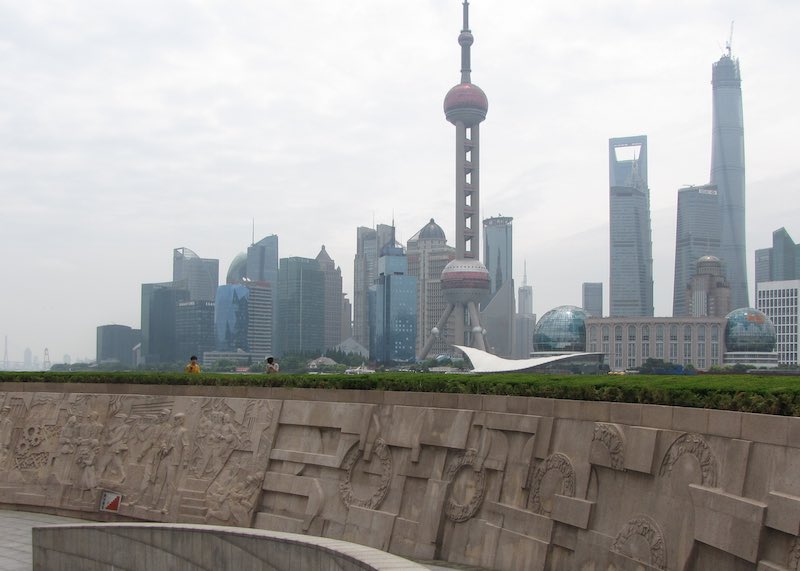
Monument to the People’s Heroes with the Shanghai skyline in the background. See more photos by John Hunter
Another thing to consider is another long term macro-economic factor may also be giving long term historical returns an extra boost. The type of economic growth from the end of World War I to 1973 (just to pick a specific time, there was a big economic slowdown after OPEC drastically increased the price of oil). While that period includes the great depression and World War II, which massively distorts figures, from the end of WW I through the 1960s Europe and the USA went through an amazing amount of economic growth.
The 10 publicly traded companies with the largest market capitalizations.
| Company | Country | Market Capitalization | |
|---|---|---|---|
| 1 | Apple | USA | $626 billion |
| 2 | Exxon Mobil | USA | $405 billion |
| 3 | Microsoft | USA | $383 billion |
| 4 | USA | $379 billion | |
| 5 | Berkshire Hathaway | USA | $337 billion |
| 6 | Johnson & Johnson | USA | $295 billion |
| 7 | Wells Fargo | USA | $270 billion |
| 8 | GE | USA | $260 billion |
| 9 | Wal-Mart | USA | $246 billion |
| 10 | Alibaba | China | $246 billion |
Alibaba makes the top ten, just weeks after becoming a publicly traded company. The next ten most valuable companies:
| Company | Country | Market Capitalization | |
|---|---|---|---|
| 11 | China Mobile | China | $240 billion* |
| 12 | Hoffmann-La Roche | Switzerland | $236 billion |
| 13 | Procter & Gamble | USA | $234 billion |
| 14 | Petro China | China | $228 billion |
| 15 | ICBC (bank) | China | $228 billion** |
| 16 | Royal Dutch Shell | Netherlands | $227 billion |
| 17 | Novartis | Switzerland | $224 billion |
| 18 | Nestle | Switzerland | $224 billion*** |
| 19 | JPMorgan Chase | USA | $224 billion |
| 20 | Chevron | USA | $210 billion |
Petro China reached to top spot in 2010. I think NTT (Japan) also made the top spot (in 1999); NTT’s current market cap is $66 billion.
Market capitalization shown are of the close of business today, as shown on Yahoo Finance.
According to this March 2014 report the USA is home to 47 of the top 100 companies by market capitalization. From 2009 to 2014 that total has ranged from 37 to 47.
The range (during 2009 to 2014) of top 100 companies by country: China and Hong Kong (8 to 11), UK (8 to 11), Germany (2 to 6), France (4 to 7), Japan (2 to 6), Switzerland (3 to 5).
Related: Stock Market Capitalization by Country from 1990 to 2010 – Global Stock Market Capitalization from 2000 to 2012 – Investing in Stocks That Have Raised Dividends Consistently – The Economy is Weak and Prospects May be Grim, But Many Companies Have Rosy Prospects (2011)
A few other companies of interest:
Facebook, USA, current market cap is $210 billion.
Pfizer, USA, $184 billion.
Toyota, Japan, $182 billion.
Read more